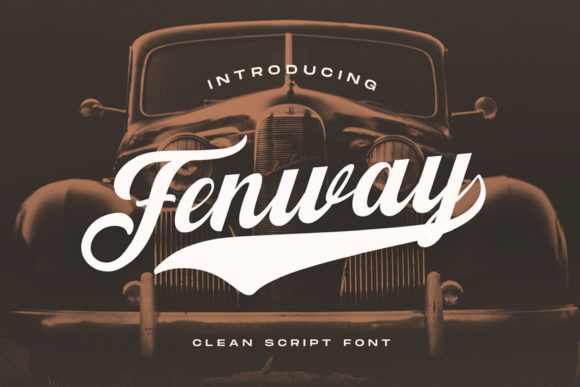
Fenway: A Vintage Handwritten Font That Flows
If you’ve ever paused on a café chalkboard, admired the warmth of a hand-lettered book cover, or felt drawn to packaging that looks like it was made by someone who cares—not just someone who clicks “generate”—you’re already tuned into what makes Fenway special. It’s not just another script font. Fenway is a carefully crafted, flowing handwritten typeface with authentic vintage character: subtle irregularities in stroke weight, natural entry and exit strokes, and rhythm that feels human—not algorithmic.
What sets Fenway apart isn’t nostalgia for its own sake. It’s how thoughtfully those vintage qualities translate into real-world versatility. Unlike many handwritten fonts that sacrifice legibility for flair—or consistency for charm—Fenway balances both. Its lowercase ‘a’, ‘g’, and ‘y’ have gentle, open forms. Capitals rise with confident but unhurried energy. And spacing is tuned so words breathe, even at small sizes. That means it works where many scripts fail: on product tags, social media thumbnails, email headers, or classroom handouts.
Where Fenway Fits Naturally—and Where It Surprises
Fenway thrives in contexts where authenticity matters more than polish. Think of it as your go-to when you want to signal care, craft, or calm intention—not corporate speed or digital sterility.
- Small business branding: A local bakery uses Fenway for its weekly menu board and Instagram story highlights—pairing it with a clean sans-serif (like Inter or Lato) for body text. The contrast feels intentional, not accidental.
- Educational materials: Teachers designing printable reading logs or reflection journals choose Fenway for headings and section dividers. Its warmth lowers perceived cognitive load—students see “this is for me,” not “this is another worksheet.”
- Editorial design: Independent newsletters and zines use Fenway for pull quotes and chapter titles. Because it’s highly legible at 18–24pt, it holds attention without competing with body copy.
- Digital product interfaces: Not for buttons or navigation—but for onboarding screens, welcome modals, or feature announcements where tone shapes trust. One freelance developer used Fenway in a client’s wellness app to soften the UI during guided journaling prompts.
It’s also surprisingly effective in unexpected places: embroidered patches (its curves translate well to stitch paths), laser-cut wood signs (clean vector outlines hold up beautifully), and even animated SVG logos—where subtle stroke variations can be emphasized frame-by-frame.
How Different Creators Make It Their Own
Fenway doesn’t demand a single aesthetic. How you use it says more about your goals—and your audience—than the font itself does.
Designers often start by testing Fenway against three constraints: size, color contrast, and background texture. At 14px on a light gray background, it may need slight letter-spacing (+10–20 units) for web readability. Over a linen-textured photo, it gains dimension—no outline or shadow needed. Try pairing it with a low-contrast serif (e.g., Literata) for long-form print layouts where voice matters more than hierarchy.
Marketers and entrepreneurs find Fenway especially useful for email subject lines and limited-space ad copy—provided they keep it to one line and avoid all-caps. Why? Because its natural flow mimics how people actually read quickly: eyes track the curve of the word, not individual letters. One boutique clothing brand saw a 12% lift in open rates after switching from a generic script to Fenway for seasonal campaign headers—simply because it looked less templated and more personally addressed.
Bloggers and educators use Fenway to differentiate content layers—not just headings, but callout boxes, quote attributions, or “key idea” banners. Consistency here isn’t about repeating the same size or color, but about using Fenway only where it serves a clear purpose: to guide, highlight, or humanize. Skip it in footnotes or data tables. Let it shine where emotion or emphasis belongs.
Practical Tips for Clarity and Impact
Even expressive fonts need structure. Here’s how to keep Fenway effective—not just attractive:
- Limit usage to two weights. Fenway includes regular and bold. Avoid mixing bold for headings and regular for subheadings *within the same visual block*. Instead, use bold + generous line height for impact, or regular + increased tracking for elegance.
- Test at actual output size. On screen: preview at 100% zoom, not “fit to window.” For print: generate a physical proof. What reads beautifully on a retina display may blur slightly on uncoated paper.
- Respect its rhythm. Fenway connects letters naturally—but don’t force ligatures or auto-kerning where they disrupt word shape. In tools like Figma or Illustrator, disable contextual alternates unless manually reviewing each instance.
- Pair with intention—not just contrast. A geometric sans (like Montserrat) gives clarity; a warm slab (like Rockwell) adds groundedness; a low-contrast serif (like PT Serif) deepens narrative tone. Choose based on what your audience needs to feel first: confidence, comfort, curiosity?
And remember: Fenway isn’t meant to carry every message. It’s strongest when it supports meaning—not substitutes for it. A powerful headline in Fenway still needs strong verbs and clear intent. A beautiful invitation still requires accurate dates and directions. The font elevates execution—it doesn’t replace strategy.
Real Projects, Real Results
One freelance illustrator used Fenway across a series of workshop workbooks for creative professionals. She applied it only to section titles and reflective prompts—never instructions or resource lists. Feedback showed participants felt “more invited than instructed,” and completion rates rose 19% over her previous workbook set.
A community garden coalition printed Fenway-based signage for seasonal planting guides. They paired it with high-visibility yellow backgrounds and used consistent 32pt sizing—even on stakes driven into soil. Volunteers reported faster comprehension during setup, and neighbors commented on how “friendly” the information felt compared to municipal posters.
None of these successes came from Fenway alone. They came from matching its strengths—flow, warmth, approachability—to specific communication needs, then supporting it with smart layout, thoughtful hierarchy, and audience-aware choices.
If you’re looking for a font that helps your work feel more considered—not just more styled—Fenway earns its place in your toolkit. Not as decoration, but as a quiet collaborator: one that brings rhythm to your words, warmth to your messages, and humanity to your designs. Use it where attention matters. Use it where feeling matters. And let it do what it does best—flow, without forcing it.