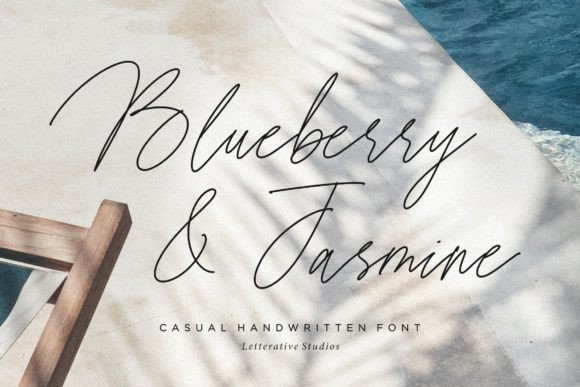
Blueberry and Jasmine: A Handwritten Font That Feels Human in a Digital World
In an era where interfaces grow sleeker, algorithms more predictive, and content feeds faster than ever, something quietly powerful is gaining ground: authenticity rooted in tactility. Not simulated texture or AI-generated “imperfection,” but the genuine warmth of hand-drawn letterforms—carefully crafted, intentionally relaxed, yet unmistakably precise. Blueberry and Jasmine arrives at this moment not as a novelty, but as a thoughtful response to how designers, brands, and storytellers are choosing to connect.
What Makes Blueberry and Jasmine Distinct—Beyond “Handwritten”
Many fonts labeled “handwritten” lean heavily into either whimsy or roughness—think chalkboard scrawls or exuberant brush scripts. Blueberry and Jasmine occupies a quieter, more intentional space. It’s casual without being careless; neat without feeling sterile. Each glyph balances soft curves with clean terminals, modest contrast, and consistent spacing—traits that make it legible at small sizes and expressive at large ones. Unlike fonts designed for single-use headlines, Blueberry and Jasmine supports extended reading in editorial layouts, subtle hierarchy in lookbooks, and cohesive tone across digital and print touchpoints.
This isn’t just about aesthetics—it’s about voice. In fashion branding, where mood and identity often outweigh literal messaging, type becomes a silent ambassador. A luxury knitwear label might use Blueberry and Jasmine for its seasonal journal captions—not to shout, but to invite slow attention. A sustainable beauty startup could apply it to ingredient stories on packaging, reinforcing transparency through approachability rather than clinical precision.
Fashion Branding in the Age of Intentional Simplicity
Fashion has shifted from spectacle to substance. Consumers increasingly favor brands that reflect values—craft, sustainability, individuality—without performative excess. Visual identity follows suit: logos grow smaller or disappear entirely; typography steps forward as a primary carrier of tone. Sans-serifs still dominate, but there’s rising appetite for human-inflected alternatives that signal care without cliché.
Blueberry and Jasmine fits this shift because it avoids nostalgia traps. It doesn’t mimic 1950s signage or vintage stationery. Instead, its rhythm feels contemporary—like handwriting you’d see in a well-curated Instagram caption, a limited-edition zine, or the handwritten note tucked inside a garment box. Its neutrality makes it adaptable: pair it with a restrained serif for editorial depth, or set it alone against generous white space for minimalist impact.
Real-world usage reflects this flexibility. A Berlin-based slow-fashion studio uses Blueberry and Jasmine for all customer-facing copy—email headers, website body text, even woven care labels—creating continuity across channels without sacrificing warmth. A Tokyo-based independent magazine applies it to pull quotes and contributor bios, letting the font’s gentle irregularity echo the handmade quality of their paper stock and ink choices.
Editorial Design Where Clarity Meets Character
Long-form editorial work faces constant tension: how to hold attention while honoring the reader’s time and intelligence. Readers scroll past dense blocks of uniform type—but they pause for rhythm, variation, and subtle cues that signal meaning. Blueberry and Jasmine functions as both text face and expressive accent. Its lowercase ‘a’, ‘g’, and ‘y’ carry quiet personality; its capitals offer restrained presence rather than dominance.
This matters most when editorial design moves beyond the page. Newsletters, digital magazines, and brand publications now live across devices—from phone screens to desktop readers. Blueberry and Jasmine scales gracefully: its open counters and balanced x-height support readability on retina displays, while its natural stroke modulation prevents visual fatigue during sustained reading.
Consider a freelance writer launching a Substack on textile history. Using Blueberry and Jasmine for article intros and pull quotes (while keeping body text in a highly legible serif) adds narrative texture—hinting at the hand behind the research, the care behind the curation. It signals that this isn’t algorithm-driven content; it’s authored, considered, human.
Workflow Realities: Accessibility, Licensing, and Practical Integration
A beautiful font loses value if it creates friction. Blueberry and Jasmine is built with modern workflows in mind—not just as a static download, but as a tool that integrates cleanly. It includes standard OpenType features like ligatures and alternate characters, enabling subtle typographic refinement without manual glyph swapping. Its file size remains lean, avoiding performance drag on websites or email clients.
Licensing is straightforward: one-time purchase with broad usage rights—including web embedding, app UI, merchandise, and client projects—so freelancers and agencies can deploy it confidently across deliverables. No subscription model, no usage caps, no surprise renewals. For educators designing course materials or small studios building brand guidelines, that predictability matters.
Accessibility considerations are also grounded in practice. While not a high-contrast sans-serif, Blueberry and Jasmine maintains clear letter differentiation (no ambiguous ‘I’/‘l’/‘1’ confusion), adequate spacing between words, and sufficient weight variation for hierarchy—all factors that support screen readers and low-vision users when paired thoughtfully with color contrast and semantic HTML structure.
Why Now? The Quiet Rise of “Quiet Luxury” in Typography
Look beyond fashion runways: “quiet luxury” describes a broader cultural recalibration—away from loud logos and toward understated confidence, away from trend-chasing toward enduring resonance. This extends to type. Brands aren’t abandoning bold statements, but they’re balancing them with moments of calm, clarity, and craft.
Blueberry and Jasmine resonates here because it doesn’t try to be everything. It doesn’t simulate handwriting so loosely that it sacrifices function; nor does it over-optimize until it loses soul. It occupies what designers call the “sweet spot”—where intention meets ease, where personality coexists with professionalism.
This isn’t about rejecting digital tools—it’s about using them to amplify humanity. When a blogger illustrates a personal essay with hand-drawn diagrams and sets the caption in Blueberry and Jasmine, the pairing feels cohesive, not contrived. When a yoga studio updates its website and replaces generic sans-serif headings with Blueberry and Jasmine subheads, the shift signals mindfulness—not just in practice, but in presentation.
Getting Started: Small Steps With Meaningful Impact
You don’t need a full rebrand to begin exploring Blueberry and Jasmine. Start with one high-impact application:
- Email signatures: Swap your default sans-serif for Blueberry and Jasmine in name and title lines—subtle, memorable, professional.
- Social media captions: Use it in Canva or Figma overlays for Instagram Stories or Pinterest pins, especially for quotes, tips, or behind-the-scenes notes.
- Editorial accents: Apply it to pull quotes, section dividers, or author bios in newsletters or blogs—keeping body text in a complementary, highly readable face.
- Printed collateral: Try it on business cards, thank-you notes, or product tags where tactile quality reinforces brand values.
Each use builds familiarity—not just with the font, but with the mindset it represents: that clarity doesn’t require coldness, and warmth doesn’t demand looseness. That good design serves people first, whether they’re scrolling quickly or pausing to read deeply.
Looking Ahead—Without Overpromising
Typography evolves incrementally, not disruptively. There won’t be a “Blueberry and Jasmine revolution.” Instead, expect steady, thoughtful adoption—by designers who prioritize coherence over novelty, by founders who understand that brand voice lives in micro-decisions, and by creators who know that the right typeface doesn’t distract from the message—it helps the message land.
What endures isn’t the font itself, but what it enables: quieter confidence in visual communication, stronger alignment between voice and values, and designs that feel made—not generated. Blueberry and Jasmine won’t solve every design challenge. But in the right context, with clear intent, it offers something increasingly rare: a way to say something meaningful, simply.