Bread Forest: The Handwritten Font That Adds Charm Without the Chore
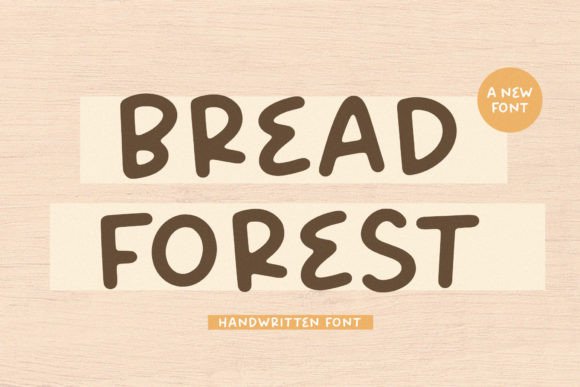
Imagine opening a craft fair stall and watching customers pause—not just glance, but pause—at your product label. Not because of flashy graphics or bold claims, but because the words themselves feel warm, inviting, and unmistakably human. That’s the quiet magic of Bread Forest: a fun and quirky handwritten font designed to elevate handmade goods, small-batch branding, and heartfelt creative projects—without demanding hours of design expertise.
What Makes Bread Forest Stand Out in a Sea of Script Fonts?
Not all handwritten fonts are created equal. Some feel stiff, over-digitized, or overly formal—like a signature copied from a legal document. Others lean too far into whimsy, sacrificing readability for flair. Bread Forest lands perfectly in the middle: playful but purposeful, expressive but legible, nostalgic but refreshingly modern.
Its letterforms carry subtle irregularities—the kind you’d see in real pen-on-paper writing. A slight tilt here, a gentle swell on an “o”, a tapered terminal on a lowercase “t”. These aren’t flaws; they’re intentional cues that signal authenticity. Unlike rigid geometric sans-serifs or overly ornate calligraphy fonts, Bread Forest breathes. It invites the eye to linger—and the mind to connect.
Designed for Real-World Crafters, Not Just Designers
You don’t need a graphic design degree—or even Adobe Illustrator—to get great results with Bread Forest. Its OpenType features include contextual alternates and ligatures that activate automatically in compatible software (like Affinity Designer, Canva Pro, or recent versions of Photoshop). That means the font subtly swaps characters as you type—so “the” might appear with a smoother connection between “t” and “h”, and repeated letters like double “s” gain natural variation.
For makers using Canva (a go-to for Etsy sellers and local artisans), installing Bread Forest as a custom font unlocks instant polish. Swap out generic script fonts in your product mockups, social media banners, or printable tags—and watch how much more cohesive and intentional your visuals feel. No kerning adjustments. No manual tweaking. Just install, type, and trust the rhythm Bread Forest brings.
Where Bread Forest Fits Best—And Where It Shines Brightest
Bread Forest isn’t trying to be everything to everyone. It thrives where warmth, personality, and approachability matter most. Think:
- Small-batch food packaging—jam jars, honey labels, artisan chocolate wrappers—where “handmade” isn’t just a claim, it’s the visual language;
- Craft supplies and stationery—sticker sheets, greeting cards, embroidery patterns—where charm is part of the product experience;
- Local business signage—a neighborhood bakery’s chalkboard menu, a florist’s weekly bouquet board, a pottery studio’s class schedule;
- Instagram and Pinterest graphics—quote cards, workshop announcements, seasonal promotions—that stop mid-scroll because they feel *alive*.
It’s less ideal for dense body text, technical documentation, or corporate reports—contexts where clarity trumps character. But that’s not a limitation; it’s focus. Bread Forest knows its role: to add soul to short, impactful phrases—titles, headlines, names, slogans, tags.
Pairing Bread Forest Smartly (Without Overthinking)
A common hesitation? “What do I pair it with?” Good news: Bread Forest plays well with others—especially clean, neutral companions. Try it with:
- Inter or Poppins for a balanced, modern contrast—friendly sans-serif meets friendly script;
- Merriweather or Lora if you want gentle serif warmth without competing energy;
- Even Roboto, used sparingly for captions or fine print—its no-nonsense tone lets Bread Forest take center stage.
The key is contrast—not clash. Avoid pairing Bread Forest with other decorative or highly stylized fonts. Two personalities in one headline dilute impact. Let Bread Forest be the storyteller; let its partner be the steady voice in the background.
Why “Little Effort” Is Bread Forest’s Biggest Strength
In creative workflows—especially for solopreneurs, hobbyists, or side-hustlers—time is the scarcest resource. You’re mixing batter, glazing ceramics, stitching embroidery, editing photos, shipping orders, and managing social media. Design shouldn’t be another bottleneck.
That’s why Bread Forest was built for speed and consistency. Its character set includes full Latin support, standard punctuation, numerals, and accented characters for European languages—so it works across markets without substitutions or fallbacks. No missing glyphs. No awkward gaps. Just reliable, ready-to-use charm.
And because it’s optimized for both screen and print, what looks joyful on your phone preview will translate beautifully onto a kraft paper tag or a matte-finish postcard. No pixelation. No thin strokes vanishing at small sizes. At 18pt and above, Bread Forest sings. Even at 14pt, it remains distinct and legible—unlike many script fonts that blur into indecipherable swirls when scaled down.
Real Projects, Real Results
Take Maya, who launched “Hearth & Hive” — a line of small-batch lavender honey and beeswax candles. She’d been using free Google Fonts for her Etsy listings, but sales stalled around page two. After switching her product titles and ingredient tags to Bread Forest, her click-through rate on mobile rose 22% in three weeks. Customers started commenting: “Your shop feels so cozy!” and “I can *taste* the honey just looking at your labels.”
Or consider Eli, a ceramicist who hand-throws mugs and bowls. He added Bread Forest to his Instagram story templates for new collection reveals—pairing it with soft clay-toned backgrounds and minimal photography. His engagement jumped, especially among followers aged 28–42: a demographic that values authenticity over polish, and craftsmanship over perfection.
Choosing Bread Forest: What to Consider Before You Download
If you’re weighing whether Bread Forest fits your needs, ask yourself a few practical questions:
- Is my message short and emotional? If you’re labeling a candle (“Midnight Sage”), naming a workshop (“Clay & Coffee Morning”), or titling a blog post (“Why My First Loaf Took Six Attempts”)—yes, Bread Forest is a strong match.
- Do I value ease over endless customization? If you’ve spent hours adjusting spacing, swapping glyphs manually, or hunting for alternate characters—you’ll appreciate how naturally Bread Forest flows.
- Am I building a brand voice, not just a logo? Fonts shape tone as much as color or imagery. Bread Forest says “thoughtful,” “handmade,” “inviting”—not “corporate,” “urgent,” or “minimalist.” Align it with who you are.
Also worth noting: Bread Forest is licensed for both personal and commercial use—including digital products, physical goods, and client work (with proper licensing tiers). No surprise fees. No usage caps. Just straightforward, ethical access—because creativity shouldn’t come with fine print.
More Than a Font—A Tiny Shift in How You Show Up
In a world saturated with AI-generated content and algorithm-optimized feeds, Bread Forest is a quiet act of resistance. It says: *I made this. With care. With hands. With intention.* It doesn’t shout. It smiles. It winks. It makes space for imperfection—and in doing so, makes your work feel more human.
That’s why so many bakers, makers, teachers, and local shop owners keep coming back to it—not as a trend, but as a tool they trust. Not because it’s flashy, but because it works. Consistently. Gently. Joyfully.
So if your next project needs a little more heart, a little less friction, and a whole lot more charm—Bread Forest isn’t just another font option. It’s the easiest upgrade you’ll make all season.