Citruslime: A Handwritten Font That Balances Artistry and Practicality
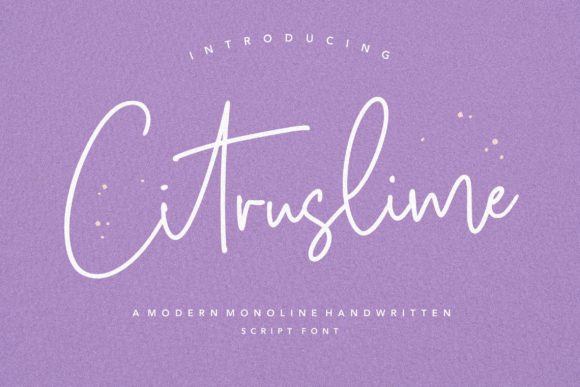
Citruslime is a carefully crafted handwritten font designed to evoke warmth, personality, and refined elegance—without sacrificing usability. Unlike many decorative script fonts that prioritize visual flair over function, Citruslime was built with real-world application in mind. Its strokes flow naturally, its letterforms retain consistent rhythm, and its spacing supports legibility even at smaller sizes. It’s not just a “pretty script”—it’s a tool shaped for creators who need expressive typography that works across digital and print contexts.
What Sets Citruslime Apart
At its core, Citruslime belongs to the category of formal calligraphic scripts—but it avoids the stiffness of traditional copperplate or the exaggerated flourishes common in display-only fonts. Instead, it strikes a middle ground: graceful enough for wedding invitations or boutique branding, yet grounded enough for social media captions or hand-lettered product labels. The subtle variation in stroke weight, the gentle tilt of lowercase letters, and the soft entry/exit strokes all contribute to a sense of organic movement—like ink laid down by a practiced hand.
One practical differentiator is its PUA (Private Use Area) encoding. This means every alternate character, swash, ligature, and stylistic variant is accessible directly from your keyboard—no need for glyph panels or complex OpenType features in basic applications like Canva or Instagram Stories. For designers working across platforms—or non-designers managing their own brand visuals—this eliminates friction when accessing expressive options like ending swashes on “y” or contextual “t” variants.
Where Citruslime Fits in Real Creative Work
Consider how typography functions in practice—not as isolated aesthetics, but as part of a broader workflow. Citruslime shines in scenarios where authenticity matters more than uniformity: artisanal packaging, personal branding for coaches or creatives, handmade greeting cards, or Instagram carousel text overlays that aim to feel human rather than algorithmic.
For example, a small-batch candle maker might use Citruslime for jar labels to reinforce a hand-poured, small-scale narrative—its slight irregularities signal care and craft, unlike rigid sans-serifs that imply mass production. Similarly, a freelance illustrator promoting workshops on Instagram may choose Citruslime for story text because its rhythm mirrors natural handwriting, helping followers pause and connect emotionally with the message—not just scan it.
Comparing Approaches: When Handwritten Fonts Align—or Don’t
Handwritten fonts fall along a spectrum—from highly structured, formal scripts to loose, sketch-like lettering. Citruslime sits near the center: more deliberate than doodle-style fonts (which often sacrifice readability at scale), but less rigid than monoline or ultra-thin calligraphic fonts (which can feel fragile or overly precious).
This positioning creates clear tradeoffs. Citruslime isn’t ideal for long-form body text—its connected script and variable spacing make extended reading tiring. Nor does it suit high-contrast branding systems that rely on stark geometric contrast (e.g., pairing a bold grotesk with a delicate script). In those cases, a bolder, more neutral script—or even a custom lettering solution—may serve better.
It also differs from system-native handwriting fonts (like those bundled with macOS or Windows), which tend to be simplified, lower-resolution, and lack nuanced alternates. Citruslime’s intentional design—including baseline consistency and balanced x-height—means it scales cleanly across devices and retains integrity in both dark-mode interfaces and printed materials.
Practical Considerations for Evaluation
- File compatibility: Citruslime is delivered as standard OTF/TTF files, making it compatible with Adobe apps, Affinity Suite, Cricut Design Space, Silhouette Studio, and most web-based editors—unlike some niche fonts requiring specific licensing tiers or cloud-only access.
- Licensing scope: Its license typically covers personal and commercial use, including merchandise and client work—important for freelancers or small studios weighing long-term flexibility against upfront cost.
- Language support: While optimized for English and Western European languages, it doesn’t extend to Cyrillic, Greek, or extended diacritics. Users needing multilingual support should verify coverage before committing.
When Citruslime Is the Right Fit—and When It Isn’t
Citruslime tends to be strongest when the goal is emotional resonance over functional neutrality. If your project benefits from perceived warmth, approachability, or artisanal credibility—such as a yoga studio’s newsletter headers, a handmade jewelry line’s website hero text, or a food blogger’s recipe card titles—it aligns well. Its PUA encoding also makes it unusually accessible for non-professionals using drag-and-drop tools, reducing reliance on design expertise.
Conversely, if your use case demands strict typographic hierarchy—say, a corporate annual report with layered headings, subheads, and body copy—Citruslime would likely serve only one tier (e.g., top-level headlines), requiring careful pairing with a complementary sans-serif or serif for supporting text. Likewise, projects emphasizing modern minimalism or tech-forward clarity may find its expressive nature visually incongruent.
Another limitation lies in customization. While Citruslime offers rich alternates, it isn’t a variable font—so you can’t dynamically adjust weight, width, or slant. Designers accustomed to fine-tuning parameters in real time may prefer variable alternatives for certain responsive layouts or animation-heavy presentations.
Alternatives Worth Weighing
No single font solves every challenge. Depending on your goals, you may want to explore adjacent options—not as replacements, but as complementary tools:
- More restrained scripts: Fonts with tighter spacing and reduced flourish offer greater versatility in mixed-layout environments (e.g., editorial spreads or multi-column web layouts).
- Monoline handwritten options: These provide consistency across weights and sizes, making them easier to pair with bold sans-serifs or integrate into icon-based interfaces.
- Custom lettering: For brands prioritizing absolute uniqueness, commissioning original hand-lettering ensures differentiation—but carries higher cost, longer timelines, and less reusability than a licensed font like Citruslime.
Making an Informed Choice
Choosing a handwritten font isn’t about finding the “most beautiful” option—it’s about matching expressive intent with technical reliability and workflow fit. Citruslime stands out for its balance: it delivers aesthetic nuance without demanding advanced software knowledge, and it supports creative intention without compromising day-to-day usability.
Before selecting it—or any script font—ask yourself: What feeling do I want this text to evoke? Where will it appear most frequently (mobile feed, printed tag, video overlay)? Who will be using it, and what tools do they rely on? How much time can be invested in learning glyph access versus needing immediate, intuitive results?
For many creators balancing artistry and efficiency, Citruslime answers those questions thoughtfully. It doesn’t try to be everything—but within its thoughtful boundaries, it performs consistently, gracefully, and with quiet confidence.