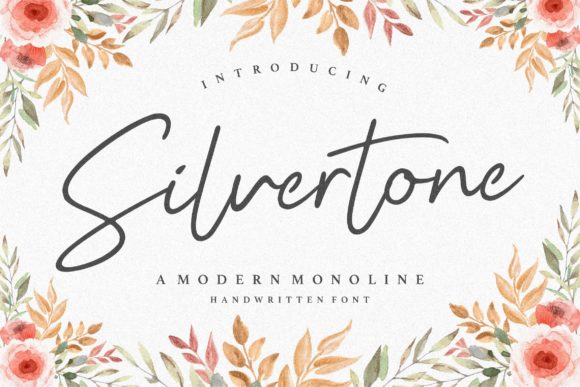
Silvertone: A Sweet, Delicate Handwritten Font That Works—When Used Right
Silvertone is a sweet and delicate handwritten font—clean, fashion-forward, and surprisingly versatile. It’s not just for wedding invites or baby shower banners. When chosen thoughtfully and applied with intention, Silvertone adds quiet elegance to branding, digital content, product packaging, educational materials, and even minimalist UI elements. Its gentle curves and consistent rhythm give it a human touch without sacrificing legibility or polish.
Why People Reach for Silvertone (and Why That’s Not Always Enough)
Many designers and small business owners gravitate toward Silvertone because it feels approachable and refined—like a thoughtful note written by hand. That’s valid. But attraction alone doesn’t guarantee success. Too often, people download Silvertone on impulse, drop it into a logo or social post, and wonder why the result feels “off”: too fragile at small sizes, too informal for a corporate report, or oddly inconsistent across devices.
The issue isn’t Silvertone—it’s context. This font thrives in environments where tone matters as much as text. It communicates warmth, care, and attention to detail—but only when paired with appropriate weight, spacing, contrast, and supporting typefaces.
Mistake 1: Using Silvertone for Body Text or Small Captions
Silvertone was designed for display—not extended reading. Its fine strokes and subtle variations lose clarity below 16px, especially on screens or low-resolution prints. Trying to use it for blog paragraphs, email footers, or app labels leads to squinting, skipped words, and higher bounce rates.
Better approach: Reserve Silvertone for headlines, quotes, callouts, or short brand statements. Pair it with a highly legible sans serif (like Inter, Lato, or Open Sans) for all body copy. In a newsletter, for example, use Silvertone for the subject line or section divider—then switch to a clean, open-typeface for the rest.
Mistake 2: Assuming All “Silvertone” Files Are Equal
You’ll find dozens of fonts named Silvertone online—including free knockoffs, outdated versions, or incomplete character sets missing diacritics, punctuation, or bold variants. Some lack proper OpenType features like ligatures or stylistic alternates; others have inconsistent kerning or poorly spaced punctuation.
This affects more than aesthetics. Missing glyphs break multilingual content. Poor spacing undermines professionalism—especially in client-facing work. And using an unlicensed version risks legal exposure if you scale your business or publish commercially.
Better approach: Download Silvertone only from reputable sources—like the original designer’s site, Creative Market, or Adobe Fonts. Check the file details: Does it include at least Regular and Bold weights? Does the preview show accented characters (é, ñ, ü)? Does the license explicitly allow commercial use, web embedding, or app integration? If in doubt, test it with your actual content before committing.
Mistake 3: Ignoring Color, Contrast, and Background
Silvertone’s delicacy becomes a liability against busy backgrounds or low-contrast color combos. Light gray Silvertone on a textured cream background may look dreamy in a mockup—but vanish entirely on a mobile screen in sunlight. Similarly, pairing it with overly ornate patterns or competing scripts dilutes its quiet charm.
Better approach: Always test Silvertone in real conditions. Preview it on multiple devices. Use WCAG-compliant contrast ratios (at least 4.5:1 for normal text). For print, check how it renders on your intended paper stock. When layering over photos or gradients, add a subtle semi-transparent overlay or soft drop shadow—not enough to distract, just enough to ensure readability.
Mistake 4: Overusing It Across Touchpoints
Seeing Silvertone everywhere—on your Instagram bio, website hero, business card, and invoice—can unintentionally flatten your brand voice. Without typographic hierarchy, everything feels equally important (and therefore, nothing stands out). Worse, it limits flexibility: what do you use when you need urgency, authority, or technical precision?
Better approach: Treat Silvertone as one voice in your brand’s vocabulary—not the whole language. Define clear usage rules: “Silvertone = headline + signature phrase only,” or “Silvertone appears only in editorial features and customer thank-you notes.” Then choose complementary fonts that handle other roles: a strong geometric sans for navigation, a warm serif for long-form writing, or a monospace for code snippets or data.
What to Check Before You Commit
- Weight range: Does the package include at least two weights? Silvertone looks most balanced with a slightly bolder variant for emphasis—avoid relying solely on faux-bold styling from design software.
- Language support: If your audience includes Spanish, French, Vietnamese, or Turkish speakers, verify the font covers those character sets—not just basic Latin.
- Licensing scope: Does the license cover your use case? A personal-use license won’t suffice for client projects, SaaS dashboards, or merchandise. Look for terms like “perpetual,” “multi-user,” or “web font hosting included.”
- Technical compatibility: Test it in your workflow. Does it load smoothly as a web font? Does it embed correctly in PDFs or Canva templates? Does it behave predictably in Figma, Illustrator, or Google Docs?
A Final Thought: Let Silvertone Breathe
Silvertone works best when it’s given room—not crammed, not forced, not expected to carry more than its graceful design intends. It’s not a utility font. It’s a tonal accent. Think of it like a well-placed watercolor wash: subtle, intentional, and far more powerful when used sparingly and with care.
If you’re building a brand, launching a course, designing a portfolio, or crafting a heartfelt message—Silvertone can elevate it. Just remember: its sweetness comes from restraint, its delicacy from precision, and its fashion-forward appeal from smart pairing—not solo performance.
Use it where warmth matters. Respect its limits. And always ask: Does this choice serve the reader—or just my initial impression?