The Crafter: A Handwritten Font for Authentic, Approachable Design
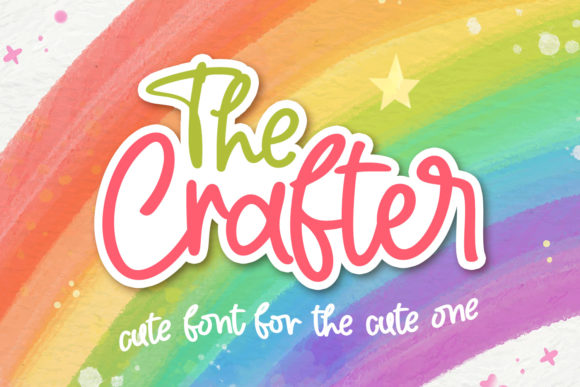
The Crafter is a handwritten typeface designed to evoke warmth, sincerity, and human touch. It features irregular stroke widths, subtle variations in letterforms, and gentle inconsistencies that mirror natural pen-on-paper writing. Unlike script fonts with exaggerated flourishes or rigid calligraphic structure, The Crafter prioritizes readability while preserving organic charm. Its lowercase letters flow with soft entry and exit strokes, and its uppercase characters retain a friendly, unpretentious character—making it suitable for both short typographic accents and moderate-length text blocks.
Designers and content creators often seek typefaces that communicate personality without sacrificing clarity. The Crafter fills that space for projects where authenticity matters—such as artisanal branding, handmade product packaging, wedding stationery, educational materials for young learners, or community-focused websites. Its visual tone suggests care, approachability, and individuality—qualities that resonate when audiences value human connection over polished uniformity.
One of the primary benefits of The Crafter lies in its versatility within expressive contexts. It scales well across print and digital applications, particularly at sizes between 16–48 pt, where its natural rhythm remains legible. The font includes standard Latin characters, numerals, and common punctuation, supporting English and many Western European languages. Its OpenType features—such as ligatures and alternate glyphs—are modest but intentional, offering light customization without overwhelming users unfamiliar with advanced typography controls.
However, practical considerations accompany its stylistic strengths. Because The Crafter mimics handwriting, it is not optimized for dense body text or extended reading. Paragraphs longer than two or three sentences may reduce comprehension speed and increase visual fatigue, especially on low-resolution screens or in small sizes. Users should also verify contrast and spacing in their intended medium: tight line-height settings or narrow column widths can cause letters to visually collide, diminishing its intended warmth.
Another factor is technical compatibility. While The Crafter is available in widely supported formats (WOFF2, TTF, OTF), some older email clients or legacy design tools may render it inconsistently—or fall back to system defaults. Testing across target platforms remains essential, particularly for responsive web use or cross-platform publishing workflows.
The Crafter excels in scenarios where voice and tone are central to communication goals. For example, a local bakery launching a seasonal menu might use The Crafter for dish names and brief descriptions—reinforcing craftsmanship and personal attention. A nonprofit organizing neighborhood workshops could apply it to event flyers and volunteer invitations, signaling openness and grassroots energy. Similarly, an illustrator building a portfolio site may pair The Crafter with a clean sans-serif for headings and body text respectively—creating visual hierarchy without competing personalities.
Conversely, alternatives may be more appropriate depending on specific requirements. If high legibility at small sizes is critical—such as in mobile app interfaces, data dashboards, or accessibility-first documents—a highly legible sans-serif like Inter, Open Sans, or Roboto would serve better. When formal elegance or tradition is required—like legal correspondence, academic publishing, or luxury branding—a refined serif (e.g., Playfair Display or Crimson Text) or a disciplined script (e.g., Great Vibes or Allura) may align more closely with audience expectations.
Designers evaluating The Crafter should ask themselves several practical questions before committing:
- What is the primary role of text in this project? Is it to inform quickly, evoke feeling, or reinforce brand identity?
- How much text will appear in this font? Will it appear in headlines only, or also in captions, pull quotes, or short paragraphs?
- Where will the final output be viewed? On high-DPI screens, printed brochures, social media thumbnails, or physical signage?
- Does the project require multilingual support beyond basic Latin? If so, does The Crafter include necessary diacritics or extended character sets?
- Is there a need for typographic flexibility—such as bold weights, italics, or condensed variants? The Crafter typically ships as a single weight, limiting options for visual contrast.
These questions help distinguish between aesthetic preference and functional fit. Choosing The Crafter because it “feels right” is valid—but pairing that intuition with concrete usage criteria increases confidence in the decision. For instance, a designer selecting it for a children’s book cover benefits from its playful yet legible forms; using it for the book’s interior text, however, may require supplementing with a complementary, more readable typeface for sustained reading.
It’s also worth noting how The Crafter interacts with other fonts. Its strength lies in contrast: pairing it with neutral, geometric, or humanist sans-serifs creates balance. Avoid combining it with other decorative or handwritten fonts, which risks visual competition and undermines hierarchy. A simple rule of thumb: if two fonts share the same underlying gesture or mood, they’re likely too similar to coexist effectively.
Licensing is another pragmatic consideration. The Crafter is typically offered under standard desktop, web, or extended licenses—each with distinct usage boundaries. Projects involving redistribution (e.g., templates sold online) or embedded use (e.g., in software or apps) may require upgraded permissions. Reviewing the license terms before integration prevents unintended compliance issues later.
Finally, consider your workflow. If you rely heavily on variable font technology or need extensive language support out of the box, The Crafter may not meet those technical needs. But if your goal is to add a consistent, personable voice to carefully curated typographic moments—and you’re willing to test and adjust spacing, sizing, and pairing—it offers reliable expressive value.
In summary, The Crafter is best understood not as a universal solution, but as a purpose-built tool. Its appeal stems from intentionality: it was made to convey friendliness, sincerity, and handmade quality—not efficiency, neutrality, or authority. Readers evaluating fonts for a specific project will benefit most by anchoring their choice in real-world usage—not just visual impression. When matched thoughtfully to context, audience, and medium, The Crafter supports communication that feels both genuine and well-considered.