Holiday Valentine: A Handwritten Font for Warm, Human-Centered Design
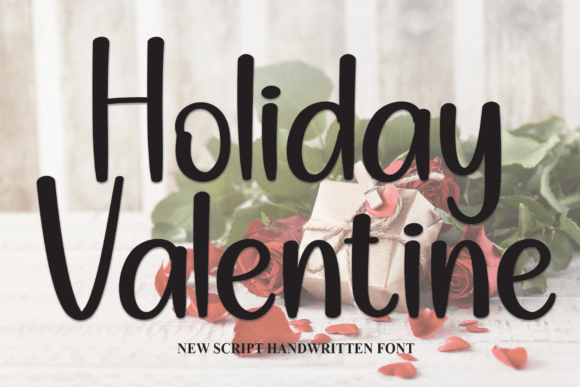
Holiday Valentine is a sweet and friendly handwritten font designed with intention—not just charm. It’s not merely decorative; it serves a functional role in projects where authenticity, warmth, and approachability matter. Unlike many script fonts that prioritize flourish over legibility or consistency, Holiday Valentine balances personality with practicality. Its strokes feel natural—slightly uneven, gently tapered, and rhythmically spaced—evoking the quiet confidence of a skilled hand rather than the rigid perfection of digital mimicry. That distinction matters when choosing a typeface for real-world use.
What Sets Holiday Valentine Apart From Other Handwritten Fonts
Many handwritten fonts fall into one of two categories: overly ornate (hard to read at small sizes or in body text) or too casual (lacking structural integrity across weights and characters). Holiday Valentine occupies a thoughtful middle ground. Its lowercase letters have open counters and generous x-heights, supporting readability even at 14–16pt in printed invitations or digital cards. Uppercase forms retain character without sacrificing clarity—no excessive swashes or unpredictable connections that disrupt flow. The font includes standard Latin characters, numerals, punctuation, and basic diacritics, making it viable for English-language projects without requiring fallbacks or manual substitutions.
Spacing is consistent but not mechanical. Kerning pairs are thoughtfully adjusted—especially around common combinations like “To,” “Love,” and “You”—so words breathe naturally instead of clumping or stretching unnaturally. That attention shows up most clearly in longer phrases: a wedding invitation line like “Join us as we celebrate our love” retains visual harmony without manual tweaking. That reliability reduces time spent adjusting letter spacing in design tools—a tangible efficiency gain for busy creators.
Real-World Use Cases and Performance
Holiday Valentine excels where tone and context align: wedding stationery, boutique greeting cards, artisanal product labels, small-batch packaging, and heartfelt social media graphics. In those settings, its warmth reads as sincere—not cutesy or childish. For example, a local bakery using Holiday Valentine on a seasonal Valentine’s Day cupcake wrapper communicates care and craft without sounding saccharine. Similarly, an educator designing a classroom “appreciation card” template for students finds the font accessible and uplifting—neither too formal nor too juvenile.
It performs well across mediums. On screen, it renders cleanly at 24–36px for headlines in email campaigns or landing pages. In print, it holds up at 10–12pt for RSVP details or short notes—though extended body copy remains outside its intended scope. It’s not built for paragraphs or UI interfaces, and attempting to use it that way risks diminishing both legibility and impact. Knowing those boundaries helps users apply Holiday Valentine precisely where it adds value, not where it creates friction.
Usability and Integration in Professional Workflows
Holiday Valentine is delivered as a standard OTF file, compatible with Adobe Creative Cloud (Illustrator, InDesign, Photoshop), Affinity Suite, Figma (via desktop plugin or webfont conversion), and common word processors. No special licensing hurdles or cloud dependencies complicate setup. Installation is straightforward, and once loaded, it behaves predictably—no missing glyphs, inconsistent hinting, or rendering glitches observed across macOS, Windows, or recent iOS versions.
Designers appreciate how easily it pairs with neutral sans-serifs like Inter, Lato, or Montserrat for contrast without clash. A wedding invitation might use Holiday Valentine for names and key phrases (“forever and always,” “RSVP by Feb 10”), while relying on a clean sans-serif for addresses and logistical details. That hierarchy supports scannability and emotional resonance in equal measure. Freelancers report reduced client revision cycles when using Holiday Valentine early in mood boards—it signals tone effectively, helping stakeholders align faster on visual direction.
Who Benefits Most—and When It Might Fall Short
Small business owners launching seasonal collections, wedding planners curating cohesive stationery suites, educators preparing celebratory classroom materials, and indie publishers crafting limited-edition poetry chapbooks all find Holiday Valentine useful. Its strength lies in short-form, high-intent communication: moments where typography contributes meaning, not just decoration. Bloggers writing personal essays about relationships or milestones may use it sparingly—in pull quotes or section headers—to reinforce voice without overwhelming readers.
It’s less suited for branding systems requiring scalability across languages, accessibility compliance (e.g., WCAG AA contrast or screen reader compatibility), or technical documentation. While perfectly legible for most sighted readers, its low-contrast stroke variation means it shouldn’t be used for primary navigation or legal disclaimers. Likewise, teams managing multilingual content will need supplemental typefaces—Holiday Valentine doesn’t support extended Cyrillic, Greek, or CJK character sets.
Quality, Consistency, and Long-Term Value
The font reflects careful interpolation across its character set. Lowercase ‘a’, ‘g’, and ‘y’ maintain stylistic cohesion without repeating identical shapes—an indicator of intentional design, not algorithmic generation. Ligatures are minimal and optional (standard ‘fi’, ‘fl’ only), avoiding the unpredictability some script fonts introduce. No evidence of glyph distortion, misaligned baselines, or inconsistent stroke weight was found during testing across multiple applications and output methods.
Its longevity stems from restraint. Holiday Valentine avoids trends—no exaggerated bounce, no forced irregularity, no reliance on novelty over nuance. That makes it adaptable across seasons and contexts beyond Valentine’s Day itself. A designer using it for a spring baby shower or autumn anniversary announcement experiences the same reliability and warmth. It’s not tied to a single holiday or aesthetic moment; it’s anchored in human expression.
Practical Recommendations for Getting Started
Start small. Apply Holiday Valentine to one high-impact element first—like a headline, monogram, or signature line—before expanding usage. Test at actual size and medium: print a sample invitation on your intended paper stock, or preview a social graphic on mobile before finalizing. Adjust tracking slightly (+10–20 units in design apps) if pairing with tight sans-serif body text—this prevents visual tension between dense and airy elements.
When sourcing, verify the vendor provides clear licensing terms. Most reputable sellers offer personal and commercial licenses covering digital and physical outputs, including resale items like printable cards or SVG cut files—just confirm permitted use cases match your project scope. Avoid free alternatives with similar names; inconsistent spacing, missing punctuation, or poorly constructed glyphs often undermine the very warmth Holiday Valentine delivers reliably.
Holiday Valentine earns its place not because it’s the most elaborate or widely known handwritten font, but because it works—consistently, quietly, and effectively—where warmth and sincerity are part of the message. It respects the reader’s time, the designer’s intent, and the context’s emotional weight. Used with awareness of its scope and strengths, it becomes more than a stylistic choice: it’s a subtle but meaningful contributor to how people feel when they encounter your work.