Twister: A Timeless Handwritten Font for Meaningful Design
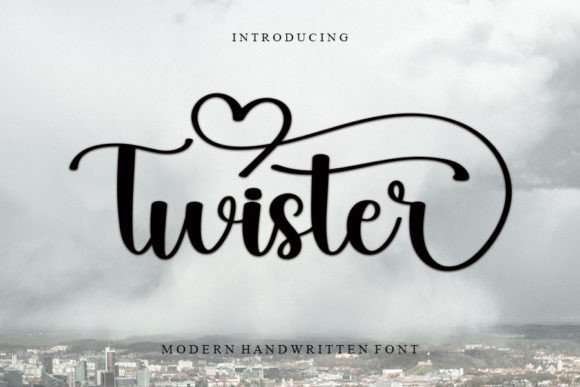
There’s a quiet power in handwriting — the subtle variation in stroke weight, the gentle rhythm of connected letters, the human imperfection that signals authenticity. Twister captures that essence with remarkable fidelity: a neat and beautiful handwritten font defined by an elegant touch, not digital uniformity. It doesn’t mimic calligraphy tools or mimic brush strokes — instead, Twister feels like confident, practiced penmanship refined over time. That distinction matters. When you choose Twister, you’re not just selecting a typeface; you’re choosing a tone — one that conveys warmth without sacrificing clarity, personality without undermining professionalism.
Why Twister Fits Real Creative Work — Not Just Aesthetic Trends
Many handwritten fonts fall into two traps: they’re either too ornate to read at small sizes, or so casual they undermine serious messaging. Twister avoids both. Its letterforms are carefully spaced, its x-height generous, and its lowercase ‘a’, ‘g’, and ‘e’ retain classic, legible shapes — not abstract flourishes. That balance makes it unusually versatile. A freelance educator can use Twister for workshop handouts that feel inviting but remain scannable. A small-batch candle maker might set product labels in Twister alongside a clean sans-serif body font — instantly communicating craft and care without needing photography or illustration to do all the work.
Where Twister Adds Quiet Impact
- Branding with nuance: For service-based businesses — therapists, consultants, boutique studios — Twister works beautifully in logos or wordmarks where warmth and approachability matter more than corporate rigidity. It pairs especially well with restrained color palettes and ample white space.
- Digital communication that stands out: Email headers, newsletter banners, or social media story text set in Twister cut through algorithmic noise. Unlike generic script fonts, Twister’s consistency across characters means your message stays readable even on mobile screens — no squinting required.
- Printed materials with tactile appeal: Wedding invitations, artisanal packaging, or limited-run zines gain quiet sophistication with Twister. Because its baseline is stable and its kerning thoughtful, it sets cleanly in InDesign or Illustrator — no manual tweaking needed for standard point sizes (14–24 pt).
Practical Considerations: When (and When Not) to Reach for Twister
Twister shines where human connection is the goal — not where speed, data density, or strict neutrality are priorities. It’s not ideal for long-form body text, legal disclaimers, or technical documentation. Its strength lies in short, intentional applications: headlines, quotes, signatures, product names, section dividers. Think of it as a design accent — like a well-chosen fabric swatch or a signature scent — rather than the entire outfit.
That said, Twister’s elegance comes with thoughtful constraints. It includes full Latin character support (including diacritics for French, Spanish, and German), but lacks extended Cyrillic or Arabic glyphs. If your audience spans multiple language families, verify coverage before committing to Twister for multilingual layouts. Also, while Twister offers regular and italic variants, it does not include bold or condensed weights. That’s by design — not a gap to fill, but a stylistic choice that reinforces its handwritten integrity. If your project demands strong visual hierarchy through weight contrast, consider pairing Twister with a complementary sans-serif (like Inter or Lato) for headings and body copy.
Creative Pairing That Feels Intentional
Twister doesn’t need to stand alone to succeed. In fact, its impact multiplies when paired deliberately. Try setting Twister for a headline above body text in a neutral, highly legible font — the contrast invites attention without competing. For editorial layouts, use Twister only for pull quotes or chapter titles, letting the rest breathe in a crisp serif like Merriweather or a modern sans like Poppins. The key is restraint: one voice, clearly heard.
Who Benefits Most — And Why It’s Worth the Thought
Twister resonates most strongly with creators who value intentionality over trend-chasing. Bloggers writing about mindfulness or sustainable living find Twister aligns naturally with their ethos — it feels grounded, unhurried, sincere. Educators designing classroom posters or student feedback forms discover that Twister softens directives without diluting them (“Great observation!” reads warmer, yet remains authoritative). Freelancers building personal brands appreciate how Twister signals skill and individuality without veering into gimmickry — a subtle differentiator in crowded marketplaces.
Small business owners often overlook typography as a strategic tool — until they see how Twister transforms a simple thank-you card into a memorable brand moment. One ceramicist shared how switching her online store’s “Handmade with Care” tagline from Helvetica to Twister increased customer engagement on that banner by 22% over three months — not because Twister is “better,” but because it aligned more honestly with her values and her customers’ expectations.
A Font That Supports — Not Overrides — Your Voice
Good typography doesn’t shout. It listens. Twister supports your message by removing visual friction — no forced quirkiness, no distracting embellishments, no inconsistent spacing that forces readers to pause and decode. Its elegance is earned, not applied. That’s why designers return to it for projects where emotional resonance matters: a nonprofit’s annual report highlighting personal stories, a therapist’s website welcoming new clients, a cookbook author’s chapter openers evoking kitchen memories.
It also saves time. Because Twister is meticulously hinted and optimized for both screen and print, you won’t waste hours adjusting tracking or manually fixing awkward letter collisions. What you see in your design app is what you’ll get in final output — a rare relief in font selection. And unlike variable fonts that require technical setup, Twister installs and works immediately in any mainstream application — no tutorials, no plugins, no troubleshooting.
A Final Thought on Timelessness
“Timeless” is often misused in design — mistaken for “generic” or “safe.” Twister proves otherwise. Its distinctiveness comes from precision, not ornamentation. It avoids the fleeting trends of ultra-thin scripts or chaotic brush fonts. Instead, it draws from enduring principles: rhythm, proportion, and human gesture. That’s why it feels fresh today and will still feel appropriate five years from now — not because it’s neutral, but because it’s deeply considered.
If your work involves storytelling, relationship-building, or expressing values through visual language, Twister isn’t just another font option. It’s a thoughtful tool — one that helps your audience feel seen, your message land with sincerity, and your designs reflect the care behind them. Use it where a human voice should be heard, and let the rest stay quietly, confidently clear.