Casey Martin: A Handwritten Font That Balances Tradition and Modernity
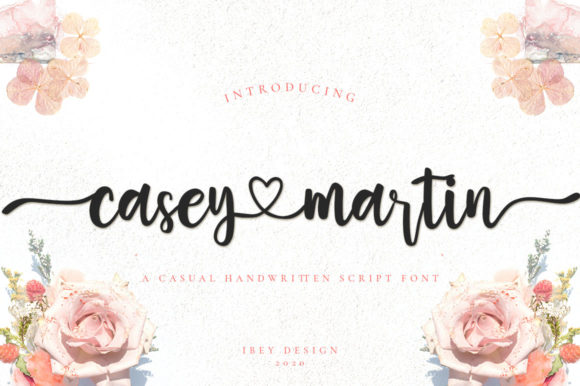
Casey Martin is an elegant, flowing handwritten font designed for designers and creators who value both artistry and functionality. Unlike many script fonts that lean heavily into either ornate calligraphy or minimalist simplicity, Casey Martin occupies a thoughtful middle ground—retaining the expressive warmth of hand-drawn lettering while delivering the polish and versatility expected in professional digital work.
What Sets Casey Martin Apart
At its core, Casey Martin is PUA (Private Use Area) encoded. This technical detail matters more than it might first appear: PUA encoding allows full access to every glyph, swash, ligature, and stylistic alternate without requiring specialized software or complex OpenType features. For users working in applications like Adobe Photoshop, Illustrator, or even modern web design tools with robust font support, this means intuitive access—no need to memorize keyboard shortcuts or toggle obscure panels just to activate a graceful terminal 's' or a delicate entry swash.
The font’s varying baseline adds organic rhythm and visual interest—letters don’t sit rigidly on a single line but rise and fall with subtle, natural variation. This avoids the mechanical uniformity found in some digitized scripts and contributes significantly to its authentic, human feel. Smooth lines, generous curves, and carefully considered spacing further reinforce its elegance. Glyphs are not merely decorative; they’re engineered for legibility at moderate sizes and impact at larger ones—making Casey Martin viable for both short headlines and extended typographic flourishes.
How It Compares Within Its Category
Handwritten fonts fall broadly into three overlapping categories: formal calligraphic scripts, casual brush-style fonts, and hybrid designs that blend structure with spontaneity. Casey Martin belongs firmly to the third group. It draws clear inspiration from pointed-pen calligraphy—notice the fine hairlines, sharp contrast between thick and thin strokes, and controlled flourishes—but avoids the rigidity sometimes associated with traditional copperplate or Spencerian styles.
Compared to highly structured calligraphic fonts, Casey Martin feels lighter and more adaptable. Where those fonts may require tight tracking and precise kerning to read well, Casey Martin includes built-in spacing that supports readability across contexts—from invitations and branding to social media graphics and editorial layouts. In contrast to looser brush scripts—which often sacrifice consistency for energy—Casey Martin maintains strong character recognition and typographic cohesion, even when using alternates.
Strengths and Practical Advantages
One of Casey Martin’s most practical strengths is its balance of personality and professionalism. It works where other handwritten fonts might falter: in brand identities aiming for sophistication without stiffness, in packaging that needs warmth without informality, or in editorial design seeking distinction without distraction. Its alternates aren’t just decorative extras—they serve functional roles. A set of contextual swashes can elevate a logo lockup; discretionary ligatures improve rhythm in longer words; and stylistic sets let designers fine-tune tone without switching fonts.
Because it’s designed with contemporary production workflows in mind, Casey Martin integrates cleanly into responsive web projects via @font-face embedding (with appropriate licensing), and performs reliably in print environments where hinting and rendering consistency matter. Its character set covers Latin-based languages comprehensively, supporting accented characters used across Western European languages—a consideration often overlooked in niche script fonts.
Where Casey Martin Excels
- Branding for lifestyle, wellness, or creative businesses — Its warmth conveys approachability, while its refinement signals quality and intention.
- Wedding and event stationery — The swashes and alternates lend themselves naturally to elegant invitations, menus, and signage without appearing overwrought.
- Digital marketing assets — Works effectively in email headers, Instagram story text overlays, or banner ads where a human touch differentiates a message in a crowded feed.
- Editorial accents — Used sparingly for pull quotes, section dividers, or chapter headings, it adds texture without compromising readability.
Tradeoffs and Considerations
No script font is universally suited to every use case—and Casey Martin is no exception. Its expressive nature makes it less appropriate for body text or interfaces requiring high scannability. You wouldn’t use it for navigation labels, data tables, or legal disclaimers. Similarly, its aesthetic leans toward the refined rather than the playful or youthful; if your project calls for exuberant energy or childlike charm, Casey Martin may feel too restrained.
Another consideration is licensing scope. Like most premium handwritten fonts, Casey Martin typically requires separate licenses for desktop, web, app, or server use. Users evaluating it alongside free or open-source alternatives should weigh not only upfront cost but also long-term flexibility—especially if their project may scale across platforms or evolve in distribution channels.
When to Choose Casey Martin—and When to Look Elsewhere
Casey Martin is often the right choice when you need a script font that communicates craftsmanship, attention to detail, and quiet confidence. If your goal is to evoke heritage without antiquation—or intimacy without informality—it aligns well with those aims. Designers selecting Casey Martin frequently report satisfaction when pairing it with clean, neutral sans-serifs (like Inter, Lato, or Montserrat) for contrast that feels intentional rather than jarring.
Conversely, consider alternative options if your project demands extreme legibility at small sizes, multilingual support beyond Western Europe, or compatibility with legacy systems that lack robust OpenType support. Likewise, if your visual language prioritizes boldness, abstraction, or experimental form, a more geometric or deconstructed script—or even a custom lettering solution—may better serve your goals.
Real-World Decision Factors
- Intended application: Is this for static print, dynamic web use, or motion graphics? Confirm format compatibility and licensing before committing.
- Audience expectations: A luxury skincare brand targeting discerning adults may benefit from Casey Martin’s restraint; a Gen Z-focused apparel line might find it too subdued.
- Production constraints: Does your team have experience managing OpenType features? While PUA encoding simplifies access, some advanced alternates still require basic familiarity with glyph panels.
- Visual hierarchy needs: Will Casey Martin be used alone or paired? Its strength lies in contrast—so assess whether supporting typefaces exist in your toolkit or budget.
Ultimately, choosing a handwritten font involves balancing subjective resonance with objective requirements. Casey Martin stands out not because it’s the most elaborate or the most minimal—but because it navigates that spectrum with uncommon poise. It doesn’t shout; it invites closer attention. It doesn’t mimic handwriting—it interprets it with discipline and grace.
For professionals evaluating options across aesthetics, function, and longevity, Casey Martin offers a compelling point of reference: one that rewards careful use, supports thoughtful design decisions, and remains distinctive without demanding attention solely for its own sake.