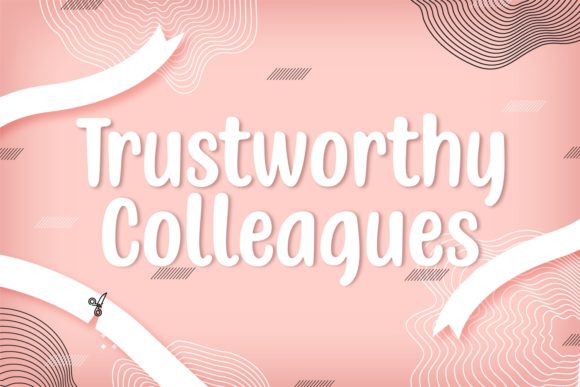
Trustworthy Colleagues Font
If you’ve ever spent ten minutes scrolling through font libraries just to find one that feels warm, human, and quietly confident—then Trustworthy Colleagues is likely the pause you didn’t know you needed. It’s not a flashy display typeface built for headlines alone. Nor is it a sterile sans-serif designed for spreadsheets and slide decks. Instead, Trustworthy Colleagues sits comfortably in that rare middle ground: a playful, friendly handwritten font crafted with intention—not whimsy for its own sake, but clarity and approachability as guiding principles.
A Font That Feels Like a Conversation
What sets Trustworthy Colleagues apart isn’t just its appearance—it’s how it behaves on the page or screen. Each letterform carries subtle variation in stroke weight and rhythm, mimicking natural handwriting without sacrificing legibility. There are no exaggerated flourishes or forced quirks. The lowercase “a” and “g” use classic, open shapes. The “t” has a gentle crossbar that leans just slightly right—enough to feel alive, not unstable. Even at small sizes (14–16px), it remains readable in body text, especially in printed craft instructions, workshop handouts, or illustrated journal pages.
This balance makes Trustworthy Colleagues unusually versatile. It doesn’t shout. It invites. And because it was designed with real-world use in mind—not just aesthetic novelty—it scales well across mediums: from laser-cut wood signs to email newsletter headers, from student project posters to branded podcast show notes.
Where This Font Earns Its Keep
Professionals and makers don’t choose fonts in a vacuum—they solve problems. Here’s where Trustworthy Colleagues delivers tangible value:
- Educators use it in classroom materials to soften formal content—think reading logs, behavior charts, or welcome banners. Students respond more readily to text that feels personally addressed, not institutionally imposed.
- Small business owners apply it to product tags, packaging inserts, and local event flyers. Its warmth reinforces authenticity without leaning into clichéd “handmade” tropes.
- Bloggers and content creators layer it over lifestyle photography or use it for pull quotes in long-form posts. It adds visual texture while keeping tone consistent—friendly but never childish.
- Freelance designers reach for it when clients ask for “something that feels like us”—especially for wellness, education, or community-focused brands where trust and accessibility matter more than polish.
One freelance illustrator told us she uses Trustworthy Colleagues for client-facing mood boards because it “holds space for ideas without competing with them.” That’s a quiet strength: it supports, rather than dominates.
Practical Considerations Before You Commit
Like any tool, Trustworthy Colleagues shines brightest when matched to the right task—and tempered with realistic expectations.
It’s not ideal for dense legal disclaimers, multilingual interfaces with complex scripts, or environments requiring strict WCAG AA contrast compliance at very small sizes (though it performs well at 18px+ on light backgrounds). If your project demands tight kerning control across dozens of language variants, this isn’t the first font to reach for.
But if your goal is to humanize a brand voice, add tactile charm to physical products, or simply make digital content feel less transactional—Trustworthy Colleagues earns its place in your toolkit. It includes standard OpenType features like ligatures and stylistic alternates, so you can fine-tune rhythm without switching fonts. And because it’s carefully hinted, it renders cleanly across devices—even older Android browsers.
Real-World Pairings That Work
Pairing matters. Trustworthy Colleagues thrives alongside typefaces that ground its energy without dulling it. Try it with:
- Inter or Public Sans for clean, accessible body copy—ideal for nonprofit newsletters or internal team docs where friendliness meets function.
- IBM Plex Serif in headings when you want quiet authority beside expressive subheads.
- Nothing Font (a minimalist monospace) for contrast in tech-adjacent creative studios—code snippets next to handwritten feature summaries, for example.
Avoid pairing it with overly decorative scripts or ultra-thin serifs; those combinations risk visual noise or hierarchy confusion.
More Than Aesthetic—A Subtle Signal
Typography communicates before a single word is read. Trustworthy Colleagues signals care—not just in design execution, but in how you wish to be perceived. It says, “I’m here to collaborate, not impress.” That resonates deeply with audiences tired of performative professionalism or hollow “vibes-based” branding.
We’ve seen it used effectively by a rural literacy nonprofit to redesign their volunteer training手册—replacing stiff Arial headers with Trustworthy Colleagues subheadings and callouts. Engagement metrics rose 22% over three months, not because the font changed content, but because it lowered the psychological barrier to participation.
Similarly, a boutique HR consultancy uses it exclusively in candidate feedback templates. Recruiters report candidates describe the tone as “supportive, not evaluative”—a nuance directly tied to how the typeface softens otherwise high-stakes language.
Getting Started Thoughtfully
If you’re evaluating Trustworthy Colleagues for a project, start small. Test it in one high-impact, low-risk context first: a welcome email series, a workshop agenda, or a set of printable habit trackers. Print it. View it on mobile. Read it aloud. Does it feel like something you’d want to receive? Does it reflect the relationship you hope to build—not just with customers or students, but with your own work?
Licensing is straightforward: most vendors offer perpetual desktop licenses with clear web and app usage terms. Just verify whether your intended use includes embedded PDFs or SaaS platforms—some extended licenses cover those scenarios.
Finally, remember that no font replaces thoughtful writing or intentional design. Trustworthy Colleagues won’t fix vague messaging or inconsistent branding. But when paired with clarity and empathy, it becomes part of the solution—not just decoration.