Hello Butterfly: A Strategic Choice for Thoughtful Typography
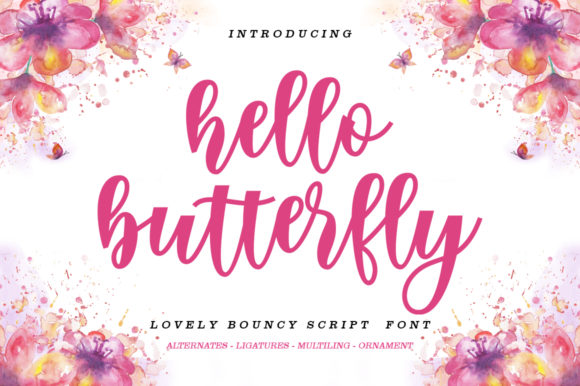
Typography isn’t decoration—it’s a functional decision with measurable impact on perception, clarity, and emotional resonance. Hello Butterfly is a beautiful and romantic handwritten font designed not just to look elegant, but to serve specific communication goals with intentionality. Its delicate curves, natural flow, and expressive swashes make it especially effective in contexts where warmth, sincerity, and personal connection matter most—wedding invitations, thank-you cards, brand storytelling, or artisanal product packaging. But its strategic value goes beyond aesthetics: Hello Butterfly is PUA encoded, meaning every alternate glyph, ligature, and decorative swash is accessible without complex software workarounds. That technical detail matters—not as a feature to admire, but as an enabler of consistency, efficiency, and creative control.
When Hello Butterfly Supports Your Goals—And When It Doesn’t
Using Hello Butterfly well starts with asking: What outcome am I trying to support? If your goal is to convey approachability, intimacy, or craftsmanship—especially in emotionally charged or highly personal communications—it aligns powerfully. A small-batch candle maker using Hello Butterfly on a limited-edition label signals care and human touch. A wedding planner embedding it into digital mood boards helps clients visualize tone before a single invitation is printed. An educator designing a heartfelt end-of-year note for students adds quiet gravitas without formality.
But Hello Butterfly is rarely the right choice when legibility, speed of reading, or broad accessibility are primary concerns. It’s unsuited for body text in long-form articles, legal disclaimers, data-heavy reports, or interfaces requiring quick scanning. Using it there doesn’t add charm—it adds friction. The risk isn’t that Hello Butterfly is “bad,” but that deploying it without alignment to purpose dilutes messaging, confuses hierarchy, and undermines credibility. Strategic typography means choosing fonts that reinforce—not compete with—your message and audience needs.
Planning Your Use of Hello Butterfly: Beyond First Impressions
Before licensing or installing Hello Butterfly, map its role within your broader communication system. Ask three questions:
- Where does authenticity outweigh neutrality? Hello Butterfly shines where generic sans-serifs feel cold—handwritten-style logos for boutique studios, monogrammed stationery for family-owned bakeries, or signature lines in email newsletters from independent coaches.
- Who needs to use it—and how often? Because Hello Butterfly is PUA encoded, team members can access swashes consistently across platforms (provided they’re using compatible software like Illustrator, Affinity Designer, or recent versions of Photoshop). That reduces version drift and design handoff errors—critical for freelancers collaborating with clients or small marketing teams managing multiple assets.
- What’s the operational cost of maintaining it? Handwritten fonts require more deliberate pairing. Pairing Hello Butterfly with a clean, highly legible sans-serif (e.g., Inter, Lato, or Montserrat) creates contrast without tension. Avoid pairing it with other script fonts—or overly ornate serifs—which risks visual noise and weakens hierarchy.
This kind of planning prevents Hello Butterfly from becoming a one-off flourish. Instead, it becomes a repeatable, scalable element of voice—one that supports recognition over time, not just attention in the moment.
Realistic Use Cases That Deliver Long-Term Value
Consider these grounded applications where Hello Butterfly contributes to measurable outcomes:
- Customer Onboarding Kits: A freelance financial advisor sends physical welcome kits to new clients. Using Hello Butterfly for the personalized welcome note—paired with a crisp sans-serif for terms and next steps—makes the first interaction feel human and considered. Clients report higher trust scores in follow-up surveys, not because of the font alone, but because the entire experience signaled care at the detail level.
- Brand Voice Anchors: A sustainable skincare brand uses Hello Butterfly exclusively for product name callouts on packaging and social thumbnails. It’s never used for ingredients, certifications, or instructions. This restraint makes the font instantly recognizable as a signal of the brand’s core promise: gentle, intentional, handmade. Over 18 months, branded hashtag usage increased 34%, suggesting stronger visual association.
- Internal Culture Materials: A remote-first education nonprofit uses Hello Butterfly in monthly “Team Spotlight” emails—only for employee names and short quotes. It subtly reinforces their values of empathy and individuality without compromising readability of the rest of the content. Engagement metrics show those emails receive 22% more replies than standard updates.
In each case, Hello Butterfly isn’t performing magic. It’s working as part of a coherent system—supporting clarity, reinforcing values, and reducing cognitive load by making key information emotionally salient.
What to Consider Before Committing
Before adding Hello Butterfly to your toolkit, assess these practical factors:
- Licensing scope: Confirm whether your intended use—especially for client work, SaaS dashboards, or web embedding—falls within the license. Some versions restrict web use or require extended licensing for commercial redistribution. Misalignment here creates legal exposure and rework later.
- Technical compatibility: While PUA encoding simplifies access to swashes, not all platforms render them reliably. Test Hello Butterfly in your email service provider, CMS, or print workflow before scaling. What looks perfect in Illustrator may default to basic glyphs in older PDF viewers or certain browsers.
- Consistency discipline: Because Hello Butterfly invites expressive variation (swashes, alternates), define clear usage rules early. Example: “Use swash capitals only for headings; avoid swashes in body copy or mobile views.” Without guardrails, even a strong font can erode visual coherence.
These aren’t obstacles—they’re checkpoints. Addressing them proactively ensures Hello Butterfly remains an asset, not an exception that requires constant correction.
Using Hello Butterfly Intentionally—Not Decoratively
Intentional use means treating Hello Butterfly as a tool for emphasis, not ornamentation. That means applying it sparingly and deliberately—like highlighting a single phrase in a quote graphic, rather than setting an entire paragraph in script. It means testing whether removing Hello Butterfly weakens the message (it should) or leaves it unchanged (a sign it’s decorative, not functional).
It also means recognizing when restraint serves better than abundance. A business card with Hello Butterfly used only for the name—and clean, structured type for title, contact info, and website—communicates confidence and clarity. The same card overloaded with swashes, flourishes, and inconsistent weights communicates uncertainty.
Finally, intentionality includes knowing when to step away. Hello Butterfly has a distinct personality: tender, lyrical, unhurried. If your brand voice is bold, technical, or urgent, it will clash—not complement. That’s not a flaw in the font. It’s a signal to choose differently, with equal thoughtfulness.
Long-Term Value Lies in Alignment, Not Novelty
Fonts gain long-term value not from how many projects they appear in, but from how consistently they reinforce what matters to your audience and your goals. Hello Butterfly endures because it delivers on a narrow, high-value promise: human warmth, executed with precision. When used with strategy—not impulse—it becomes part of a larger pattern of thoughtful decisions: in messaging, in design systems, in client interactions, in internal culture.
That pattern compounds. A vendor who notices your consistent, considerate typography begins to associate your brand with reliability. A customer who receives a Hello Butterfly–accented thank-you card after a purchase feels seen—not marketed to. A collaborator who receives a clearly structured brand guide including Hello Butterfly usage rules spends less time guessing and more time executing.
So evaluate Hello Butterfly not by how lovely it looks in isolation—but by how well it serves your next real-world objective. Does it clarify? Does it connect? Does it scale without breaking? If yes, it’s more than a font. It’s infrastructure for intention.