Goldstick Font
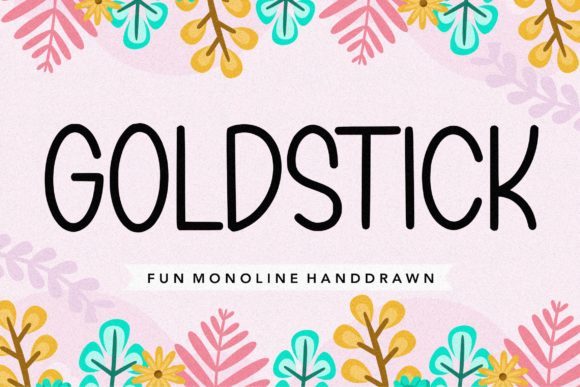
Goldstick is a monoline handwritten typeface designed with consistent stroke width and natural, flowing letterforms. It avoids the dramatic contrast of calligraphic fonts and omits decorative flourishes, resulting in a clean yet expressive hand-drawn aesthetic. Its design prioritizes legibility at moderate sizes while retaining warmth and personality—traits that distinguish it from both rigid sans-serifs and ornate script fonts.
Why Consider Goldstick?
Designers and brand creators often seek typefaces that balance authenticity with versatility. Goldstick appeals to those needing a human touch without sacrificing clarity or scalability. Its monoline structure makes it more adaptable than variable-weight scripts across digital and print contexts. Users commonly explore Goldstick when developing visual identities where approachability and modern simplicity are priorities—such as artisanal product packaging, boutique branding, editorial layouts, or social media graphics intended to feel personal rather than corporate.
Key Benefits
- Consistent readability: Uniform stroke weight supports legibility in headings, short quotes, and display settings—even on mobile screens or textured substrates like kraft paper.
- Effortless integration: Works well alongside neutral sans-serif or serif companions (e.g., pairing Goldstick headlines with Inter or Lora body text), enabling clear typographic hierarchy without visual competition.
- Flexible application scope: Suitable for wedding invitations where elegance meets informality, magazine pull quotes requiring emphasis without dominance, and Instagram story text overlays that must remain legible against busy backgrounds.
- Low technical friction: As a standard OpenType font, Goldstick installs and renders reliably across common design tools (Adobe Creative Cloud, Figma, Affinity apps) and web platforms using @font-face or variable font hosting services.
Tradeoffs and Practical Considerations
Like any specialized typeface, Goldstick has boundaries. Its monoline nature means it lacks the dynamic rhythm of true brush or pen-based scripts—so it may feel less expressive in contexts demanding high emotional nuance, such as luxury cosmetics or fine art announcements where subtle stroke variation conveys craftsmanship. Additionally, Goldstick is not optimized for extended body text: its connected lowercase forms and modest x-height reduce reading speed and comfort beyond short phrases.
Another consideration is language support. Goldstick typically covers Latin-based character sets (including accented characters used in Western European languages), but does not extend to Cyrillic, Greek, or East Asian scripts. Projects targeting multilingual audiences may require supplemental typefaces or fallback strategies.
Spacing and kerning are well-tuned for English-language use, yet custom adjustments may be needed for specific word combinations—especially all-caps settings or tight tracking in logos. Previewing real-world usage (e.g., mockups of actual packaging or social posts) helps identify spacing issues before finalizing layouts.
When Goldstick Is a Strong Fit
Goldstick performs best in scenarios where tone matters more than density. It shines in branding for small-batch food producers, indie book publishers, wellness studios, or creative agencies emphasizing transparency and craft. Its informal yet polished demeanor suits product labels where consumers value authenticity—think honey jars, ceramic studio tags, or handmade soap wraps.
For digital use, Goldstick works effectively in hero sections with ample negative space, Instagram carousel titles, or email newsletter headers—provided background contrast meets WCAG 2.1 AA standards (minimum 4.5:1 for normal text). Its light texture also holds up well over subtle gradients or soft-focus imagery, unlike heavier scripts that can visually overwhelm.
When Alternatives May Be More Appropriate
If your project requires strong emphasis on tradition or formality—such as formal wedding stationery with engraved aesthetics or heritage brand rebranding—fonts like Playfair Display (serif) or Great Vibes (high-contrast script) may better convey gravitas. Similarly, if you need a handwritten style that supports longer passages—like blog post intros or illustrated children’s books—Quicksand or Caveat offer greater openness and vertical metrics suited to paragraph use.
For accessibility-first initiatives (e.g., government communications or educational materials), prioritize fonts with tested screen-reader compatibility and robust font loading behavior. While Goldstick itself poses no inherent accessibility barriers, its decorative intent means it should remain reserved for non-essential text—never replacing system fonts for interface labels or navigation elements.
Making an Informed Choice
Evaluating Goldstick isn’t about whether it’s “good” in absolute terms—it’s about alignment with your specific constraints and goals. Start by listing your top three typographic requirements: Is it legibility at 24px on a dark mode UI? Distinctiveness in a crowded retail shelf? Consistency across five language variants? Then test Goldstick against those criteria using real content—not lorem ipsum.
Download a trial version and apply it to representative assets: a product label mockup, a social media ad frame, and a print-ready invitation layout. Compare how it behaves next to your existing brand fonts and assess whether it enhances or dilutes visual cohesion. Pay attention to rendering differences across browsers and devices—particularly how anti-aliasing affects edge clarity on Windows versus macOS.
Also consider licensing scope. Goldstick is typically available under desktop, web, and app licenses with distinct usage limits. If your project involves embedded use (e.g., a mobile app displaying user-generated quotes in Goldstick), verify that the license permits runtime font embedding—not just static export.
Finally, reflect on longevity. Handwritten fonts trend quickly; Goldstick’s restrained execution gives it stronger staying power than highly stylized alternatives, but it still signals a particular moment in design sensibility. Ask whether the voice it projects will remain relevant two or three years from now—or whether neutrality might serve your brand better over time.
In summary, Goldstick is a purpose-built tool—not a universal solution. Its value emerges most clearly when matched deliberately to contexts where warmth, simplicity, and controlled expressiveness are strategic assets. Understanding its scope, limitations, and realistic implementation demands allows designers to deploy it with intention—not assumption.