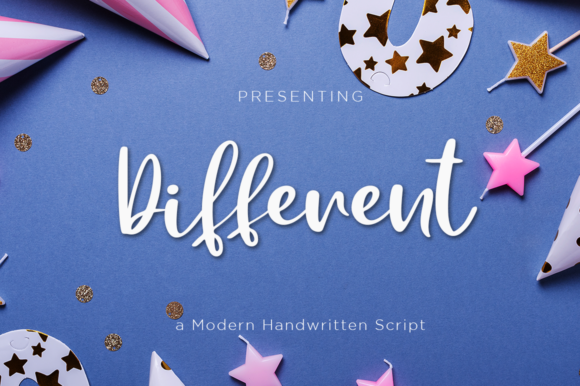
Different
Different isn’t just another handwritten font—it’s a deliberate visual choice with functional weight. Designed with irregular baseline shifts, subtle ink variation, and uneven stroke contrast, Different mimics the warmth and intentionality of human handwriting without sacrificing legibility or versatility. It’s not “cute” by accident; it’s expressive by design. That distinction matters—especially when your goal isn’t just to decorate, but to communicate with clarity, authenticity, and strategic resonance.
Why “Different” Fits Real Work—Not Just Aesthetic Trends
For entrepreneurs launching a boutique skincare line, educators designing workshop handouts, or freelancers building pitch decks, typography is rarely about decoration alone. It’s part of a decision chain: What impression do I want to land *before* the first sentence is read? How does this choice support—not undermine—the credibility, warmth, or precision my audience expects?
Different works where consistency needs texture—not uniformity. Unlike rigid sans-serifs that signal efficiency (and sometimes coldness), or overly ornate scripts that obscure meaning, Different occupies a middle ground: approachable but intentional, informal but controlled. That balance makes it unusually effective for contexts where trust hinges on perceived humanity—like email headers in nurture sequences, slide titles in client presentations, or product labels for handmade goods.
Strategic Use Cases—Not Just “When It Looks Nice”
Use Different where you’re intentionally softening tone without sacrificing professionalism:
- Instagram story text overlays: When your brand voice leans empathetic (e.g., mental wellness coaching or sustainable fashion), Different adds warmth to short-form messages without competing with imagery.
- DIY project templates: For printable planners, habit trackers, or wedding stationery sold on Etsy, Different signals craftsmanship—users associate its irregularity with care, not carelessness.
- Email subject lines or preview text: In crowded inboxes, a single line set in Different stands out—not because it’s flashy, but because it breaks pattern while remaining readable at small sizes.
- Internal team documentation headers: When drafting SOPs or onboarding guides, using Different for section titles (paired with a clean body font like Inter or Lato) subtly signals “this is made for people—not systems.”
What Happens When You Use It Without Strategy?
Typography decisions compound. Using Different everywhere—on legal disclaimers, data tables, or multi-step instructions—introduces friction. Its natural variation slows scanning. That’s fine for a headline meant to be absorbed slowly. It’s counterproductive for information meant to be parsed quickly.
More critically, overuse dilutes its strategic value. If every slide, social post, and invoice uses Different, it stops communicating “thoughtful humanity” and starts reading as “default decoration”—a visual placeholder rather than an intentional cue. That erodes differentiation, the very quality the font’s name promises.
How to Decide—Not Just Default
Before applying Different, ask three questions:
- What action do I want the reader to take next? If the answer is “pause, reflect, connect,” Different may reinforce that. If it’s “scan, compare, decide,” choose something more neutral.
- Where does this sit in the user’s journey? Early touchpoints (a welcome email, homepage hero text) benefit from Different’s approachability. Later-stage assets (pricing pages, contract terms) usually demand clarity over charm.
- Does it coexist well with my core type system? Different thrives when paired with a highly legible, low-contrast sans-serif for body copy. Avoid pairing it with other decorative fonts—or worse, multiple handwritten styles. Contrast creates hierarchy; clutter creates confusion.
Practical Pairing & Production Notes
Different performs best at sizes 24px and up for display use—and only down to 16px if tightly tracked and used sparingly (e.g., a single-line callout). Its OpenType features include contextual alternates, which help avoid repetitive glyph patterns when typing longer phrases. Enable those in Figma, Illustrator, or modern web CSS (font-feature-settings: "calt";) to preserve its organic rhythm.
For web use, serve Different as a variable font if available—or at minimum, subset it to Latin characters plus essential punctuation. Don’t load the full 500+ glyph set for a simple Instagram graphic. Performance impacts perception: slow-loading custom fonts delay comprehension before users even register the message.
Long-Term Brand Alignment—Beyond the First Impression
Consider how Different supports your brand’s evolution—not just its current state. A freelance graphic designer might use it confidently in 2024 portfolio headlines, knowing it conveys creative fluency. But if they pivot into corporate training by 2027, that same font could unintentionally undercut authority—unless consciously adapted (e.g., using it only for learner-facing materials, not executive summaries).
That’s why documenting *why* you chose Different matters as much as choosing it. Note it in your brand guidelines: “Different is used for human-centered messaging—welcome sequences, workshop materials, and community-facing visuals. It is never used in financial reports, technical documentation, or regulatory disclosures.” Clear boundaries prevent drift and maintain strategic coherence over time.
A Note on Licensing & Operational Fit
Verify licensing scope before deployment. Some versions of Different allow web embedding but restrict SaaS platform integration; others permit unlimited use across print, web, and apps—but require attribution in open-source projects. Misalignment here isn’t just legal risk—it’s operational friction. Imagine rebuilding a Shopify theme because the font license didn’t cover dynamic product badges, or pausing a client launch to renegotiate terms.
Ask your foundry or marketplace: Does this license cover automated generation (e.g., personalized certificates via Airtable)? Does it extend to white-labeled tools you resell? These aren’t edge cases—they’re daily realities for educators building course platforms or agencies delivering templated social kits.
Final Thought: Different Is a Verb, Not Just a Noun
The most effective use of Different isn’t about making things “look handmade.” It’s about making choices that reflect deeper priorities: favoring resonance over reach, clarity over cleverness, and intention over inertia. When you choose Different, you’re not selecting a style—you’re committing to a stance: that some messages deserve slowness, some audiences need warmth before logic, and some brands grow not by blending in, but by aligning every detail—including type—with what truly matters to the people they serve.