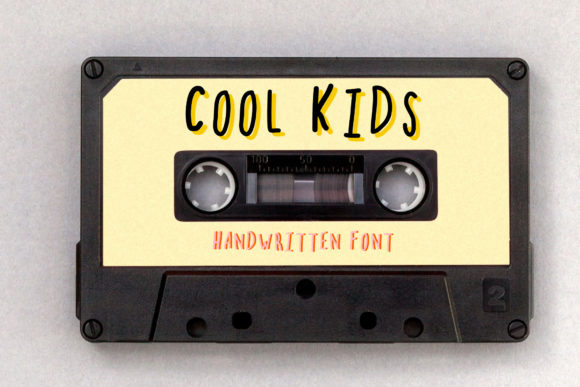
Cool Kids
Cool Kids is a playful and friendly handwritten font—think of it as the kind of script you’d see on a cheerful birthday banner, a handmade greeting card, or the chalkboard sign outside your favorite neighborhood café. It’s not overly polished or rigid; instead, it feels warm, approachable, and full of personality. That’s exactly why designers, educators, small business owners, crafters, and even busy parents reach for Cool Kids when they want to add charm without sacrificing clarity.
Where Cool Kids Fits Naturally (and Where It Doesn’t)
Fonts aren’t one-size-fits-all—and Cool Kids shines brightest in contexts where authenticity, warmth, and lightness matter more than formality or precision. It’s ideal for projects that invite connection rather than command attention.
Web Headers & Digital Banners
If you run a blog about mindful parenting, a small-batch candle shop, or a local yoga studio, Cool Kids works beautifully for hero section headers or newsletter banners. Its rounded letterforms and gentle slant give digital spaces a human touch—especially helpful when your audience is scrolling quickly and needs to feel welcomed, not lectured. Just avoid using it for long paragraphs or mobile navigation menus: its casual rhythm doesn’t scale well for dense or functional text.
Blogs & Social Media Graphics
Bloggers covering topics like seasonal crafts, home organization tips, or kid-friendly recipes often use Cool Kids for featured quote graphics or section dividers. On Instagram or Pinterest, a short phrase in Cool Kids over a soft pastel background stops scrollers mid-feed—not because it’s flashy, but because it feels *intentionally kind*. One lifestyle creator told us she swaps fonts seasonally: Cool Kids appears most often in spring and summer posts, paired with hand-drawn icons and linen-textured backgrounds.
Craft Projects & Printable Kits
This is where Cool Kids truly comes alive. Teachers print classroom labels (“Snack Time,” “Quiet Corner”) in Cool Kids to soften transitions for young learners. Scrapbookers layer it over watercolor paper for journal covers. Etsy sellers bundle printable party kits—think “Happy Birthday,” “Thank You,” or “Let’s Celebrate!”—and consistently report higher engagement when Cool Kids is included as a headline option. Its irregular baseline and subtle variation in stroke weight mimic real handwriting, making DIY projects feel less templated and more heartfelt.
Who Benefits—and How
Different users lean into Cool Kids for different reasons—and those reasons say more about their goals than their design skills.
- Small business owners use it to reinforce brand voice—especially if their messaging centers around care, creativity, or community. A boutique florist might pair Cool Kids with a clean sans-serif for body text: the contrast says “thoughtful, not stiff.”
- Educators and homeschoolers choose it for visual consistency across learning materials. One kindergarten teacher shared how she prints weekly “Focus Words” in Cool Kids alongside illustrated cards—students recognize the font as “our word time,” building familiarity and comfort.
- Content creators targeting Gen X and younger millennials find Cool Kids resonates with audiences who appreciate nostalgia without irony. It evokes childhood summers, handwritten notes passed in class, or the first time you made something just for fun—not for likes.
- Nonprofits and community groups use it in event flyers and volunteer thank-you graphics. Its friendliness helps reduce perceived distance between organizers and participants—critical when asking for time, donations, or collaboration.
What to Keep in Mind Before You Use It
Like any expressive font, Cool Kids works best when matched thoughtfully to context, audience, and purpose. Here are practical considerations—not rules, but observations from real use:
- Legibility at small sizes: While charming at 36pt+, Cool Kids starts to blur below 18pt on screen and 14pt in print. Reserve it for headlines, callouts, and decorative elements—not captions, footnotes, or data tables.
- Contrast matters: It pairs best with simple, uncluttered backgrounds. Busy textures, low-contrast colors (like light gray on white), or overlapping patterns can make letters visually “float” or disappear. Try it against solid pastels, creamy off-whites, or muted earth tones.
- Not for formal or technical settings: Legal disclaimers, academic citations, medical instructions, or financial disclosures need clarity above charm. Cool Kids isn’t built for authority—it’s built for invitation.
- Licensing is straightforward—but check it: Most versions of Cool Kids include personal and commercial licenses, but usage rights vary by vendor. If you’re embedding it in a client website or selling digital products that include the font file, verify permissions upfront.
Strengths That Make It Worth Your Time
What keeps people coming back to Cool Kids? It’s not novelty—it’s reliability in specific emotional terrain.
First, it’s consistent in its inconsistency. Unlike fonts that try to look “handwritten” but end up feeling robotic, Cool Kids includes natural alternates for letters like “a,” “g,” and “e”—so repeated words don’t look copy-pasted. That subtlety reads as human, not AI-generated.
Second, it scales well across mediums. Whether you’re laser-cutting wooden signs, printing fabric labels, or animating a short social video, Cool Kids holds up without needing heavy outlining or shadow effects.
Third—and this surprises many—it’s surprisingly versatile within its lane. Flip the color scheme (deep navy instead of coral), adjust letter spacing slightly, or layer it over a subtle grain texture, and Cool Kids shifts from “playful preschool” to “refined artisanal”—all while staying true to its core voice.
A Note on Alternatives (and Why You Might Still Choose Cool Kids)
There are dozens of friendly handwritten fonts out there. Some are bolder, some more delicate, some with extra swashes or ligatures. But Cool Kids stands out for its balance: relaxed enough to feel genuine, structured enough to remain readable, and neutral enough to adapt to many tones—sweet but not saccharine, casual but not careless.
You’ll know Cool Kids is right when the goal isn’t to impress with complexity, but to connect with quiet confidence. When your message is “I made this for you,” not “Look what I can do.” When the feeling you want to leave behind is warmth—not wow.